
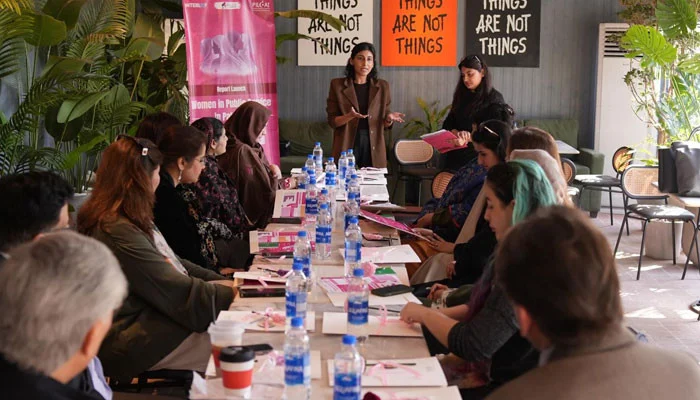
Lahore: Marking National Women’s Day on February 12, the Pakistan Institute of Legislative Development and Transparency (PILDAT) highlighted persistent structural barriers limiting women’s leadership in public service despite constitutional safeguards and affirmative policies.
The report, titled “Women in Public Service in Pakistan: Barriers and Recommendations,” was prepared with support from Interloop Limited and launched at an event attended by women leaders from politics, civil service, law, media, and civil society. PILDAT President Ahmed Bilal Mehboob and Provincial Ombudsperson for Protection against Harassment Nabila Hakim Ali Khan were also present.
According to the study, while women hold around 22% of seats in the National Assembly, they chair fewer than 10% of standing committees. Of 31 federal ministers, only one is a woman. Women make up 5.1% of the federal civil service — mostly below BS-17 — 3.2% of the police force, and 5.5% of judges in superior courts.
Although 85% of respondents observed improved representation over the past decade, only 35% believed women’s voices were adequately reflected in decision-making. The report identifies socio-cultural norms, work-life balance pressures, weak enforcement of laws, and exclusionary workplace practices as major barriers, recommending stronger law enforcement, gender audits, merit-based recruitment, safer workplaces, and family-friendly policies to enhance women’s meaningful participation in leadership roles.